TRAINING
Training with IMR
Attachment training refers to a structured postgraduate training placement undertaken by students enrolled in a Master’s programme (e.g., Master of Pathology) as part of their academic requirements. The training is conducted under supervision to enhance specialized knowledge, clinical competencies, and professional skills in a relevant discipline.
1. Official request letter for attachment from the organization/institution, addressed to the Director of IMR, including the following details:
Objectives of the training
Proposed training dates and duration
Unit/centre for attachment
Name of the supervisor at IMR
Note: The letter must be submitted to IMR at least three (3) months prior to the proposed training start date.
2. Supporting documents (if any)
1. The applicant needs to specify the centre/unit for the training placement.
2. The training period shall not exceed six (6) months. Any extension requires submission of a new application.
3. Requirements for foreign applicants:
Subject to guidelines (Guidelines of MOH Facilities Usage for the Purpose of Training Students/ Trainee Charities 2nd Ed. 2021) as stipulated by the MOH.
Training must be conducted within the validity period of the applicant’s visa.
4. Training fees are based on the approved circular (Ref: (3) KKM400-9/1/3 Jld. 13) dated 19 February 2020.
5. Complete applications with supporting documents must be submitted at least one (1) month before the training start date. Applications are subject to review and approval by the responsible IMR officer.
6. Confidentiality and data restrictions:
All information, data, experimental results, and documents obtained during the training are the property of the Institute for Medical Research (IMR) and may not be removed, shared, or used without written approval from the IMR Director
Trainees are strictly prohibited from removing any data, in physical or digital form, from IMR premises.
7. Applicants must declare the source of funding for any proposed collaborative project. IMR will not provide funding unless the project involves IMR as a collaborating research partner.
8. Applicants must comply with all safety regulations of the National Institutes of Health (NIH) premises and adhere to the prescribed dress code.
9. Access cards must be returned to the Security Unit upon completion of training.
10. IMR reserves the right to terminate the training at any time in the event of a breach of these terms.
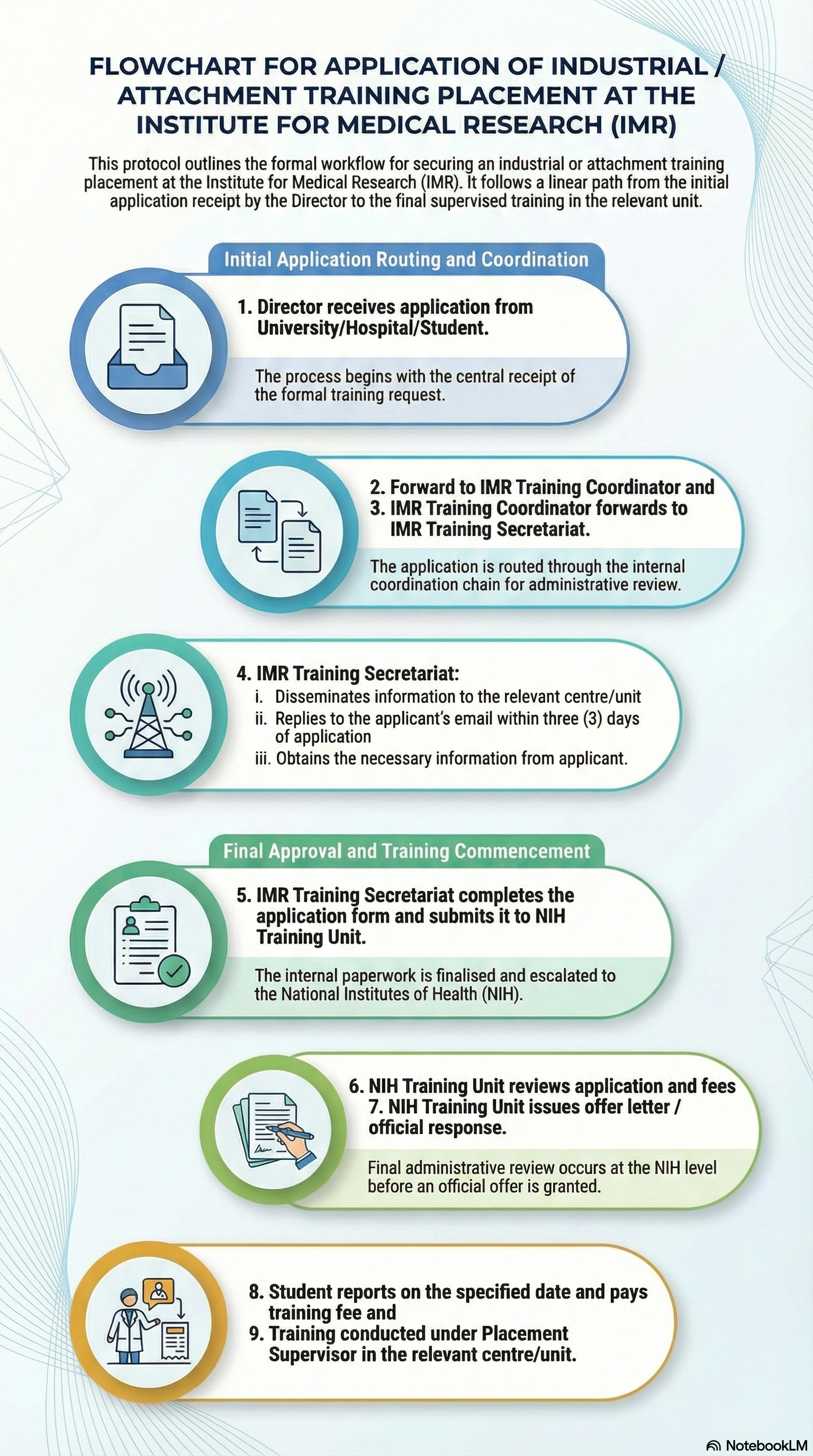
Industrial training refers to a structured training placement undertaken by undergraduate students as part of their academic curriculum. The purpose is to provide practical exposure to the workplace, enabling students to apply theoretical knowledge, develop technical skills, and gain relevant industry experience.
1. Official application letter from the student’s university/organization, addressed to the Director of IMR, including the following information:
Objectives of the training
Proposed training date and duration
Note: The letter must be submitted to IMR at least three (3) months prior to the proposed training start date.
2. Proof of insurance coverage
3. Resume with passport-sized photo
4. Verified copy of Mini Transcript (from the first semester to the most recent/latest semester)
5. Verified copy of identity card
6. Verified copy of student card
1. The training period shall not exceed six (6) months. For postgraduate students requiring a training period exceeding six (6) months, a new application must be submitted and will be subject to consideration.
2. Accommodation facilities and training allowances are not provided by IMR.
3. The Training Coordinator is responsible for evaluating applications to ensure suitability and that they do not impose an excessive burden on IMR officers.
4. Students are not allowed to select or determine their training placement at IMR. Placement will be determined based on availability and the willingness of officers to accept trainees.
5. During the training period, students will be exposed to the real working environment and the daily scope of work of a researcher at IMR.
6. Confidentiality and data restrictions:
All information, data, experimental results, and documents obtained during the training are the property of the Institute for Medical Research (IMR) and may not be removed, shared, or used without written approval from the IMR Director
Trainees are strictly prohibited from removing any data, in physical or digital form, from IMR premises.
7. IMR is not responsible for providing research proposals for students, except for projects conducted under formal collaboration with universities.
8. Any project proposals submitted by universities must undergo IMR review. Consideration for collaboration will only be given if the proposal is deemed suitable.
9. The Institute for Medical Research (IMR) will not provide financial funding for research projects proposed by universities. Therefore, students or universities are responsible for declaring the funding source for each proposed project.
10. Requirements for foreign applicants:
Subject to guidelines (Guidelines of MOH Facilities Usage for the Purpose of Training Students/ Trainee Charities 2nd Ed. 2021) as stipulated by the MOH.
Training must be conducted within the validity period of the applicant’s visa.
11. Industrial training fees are based on the approved circular (Ref: (3) KKM400-9/1/3 Jld. 13) dated 19 February 2020.
12. Training applications will only be considered after the university’s conditions have been reviewed and agreed upon by IMR officers.
13. Students must return their access cards to the Security Unit upon completion of the training period.
14. Students must comply with all safety regulations of the National Institutes of Health (NIH) premises and adhere to the prescribed dress code and standards of appropriateness.